
You Are Naturally Asymmetrical

Why asymmetry is normal and when it may start to matter
Your body was never designed to be perfectly symmetrical.
Have you ever looked in the mirror and noticed that one shoulder sits slightly higher, your pelvis feels uneven, or one side of your body seems to move differently from the other?
When we notice these differences, we often assume that something is wrong.
A higher shoulder must need to be corrected. An uneven pelvis must need to be levelled. A rotated trunk must need to be straightened.
But before jumping to that conclusion, there is one important question we need to ask:
Was the human body ever meant to be perfectly symmetrical?
The truth is, the body is asymmetrical by design. And that asymmetry does not automatically mean dysfunction.
01. The Human Body Is Asymmetrical from the Beginning
From the outside, the body appears fairly balanced. We have two arms, two legs, two sides of the rib cage, and two sides of the pelvis.
But internally, the story is different.

Your right lung has three lobes, while your left lung has only two, making space for the heart.
Your heart sits slightly left of centre.
Your liver occupies more space on the right side of the abdomen.

Even the diaphragm, one of the most important muscles for breathing, is not perfectly symmetrical. In most people, the right side sits slightly higher than the left.
So although the body looks symmetrical from the outside, its internal structure is not built that way.

That means asymmetry is not automatically a flaw, it is part of normal human design.
02. Asymmetry Also Appears in Movement
Asymmetry is not only about anatomy. It also shows up in how we move.
Most people have a preferred hand, a preferred leg, and movement habits that are slightly different from one side to the other.
You may stand more comfortably on one leg.
You may rotate more easily in one direction.
You may shift weight more naturally to one side.
This is not unusual.
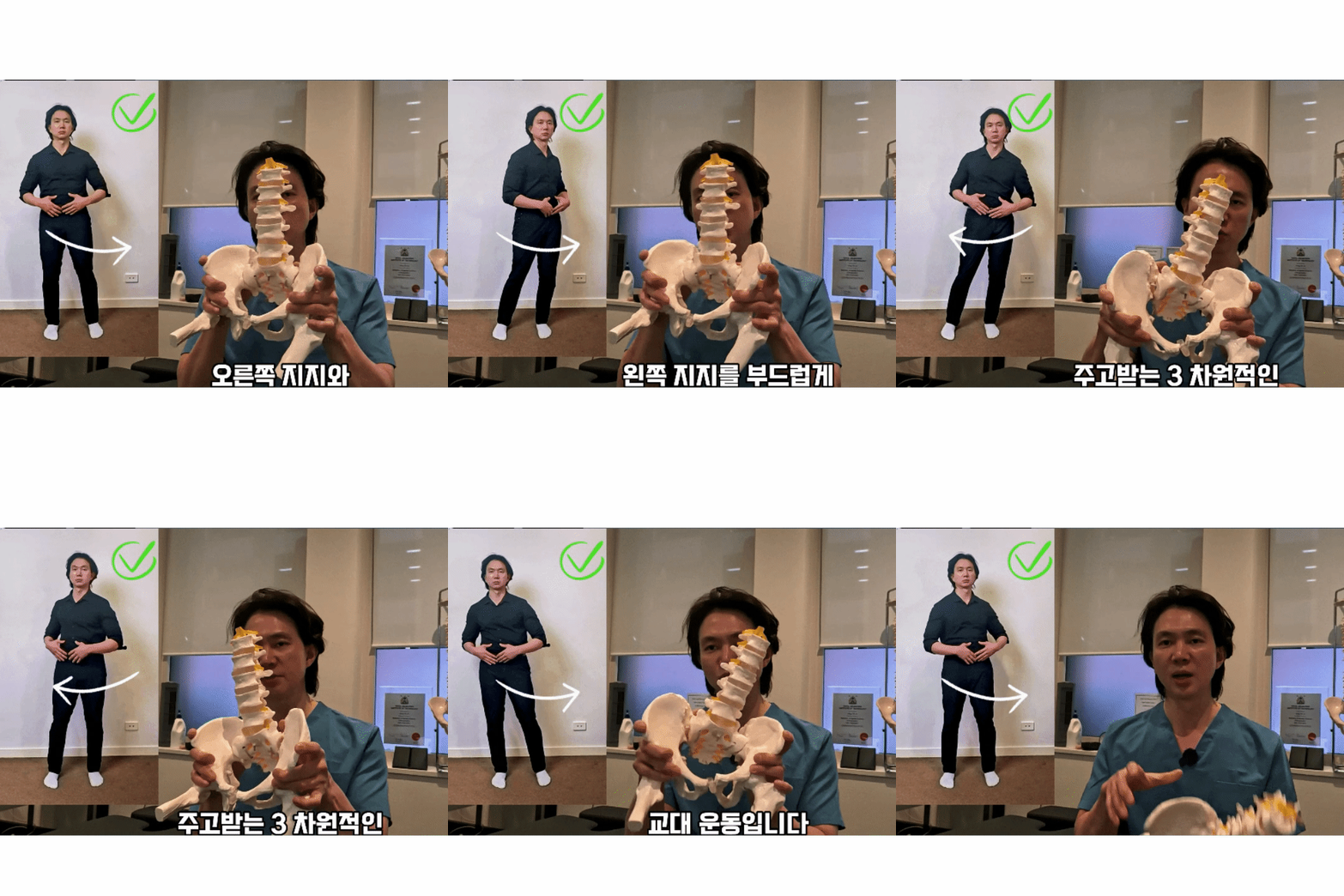
Walking itself is based on alternating asymmetry.

When your right leg is on the ground, your left leg is moving forward. Then the roles switch. During that process, the pelvis rotates, the rib cage rotates, and each hip and foot takes on a different role at a different time.
So normal walking is not a state where both sides do the exact same thing at the exact same moment.
Healthy movement depends on the ability to alternate between sides, not on both sides being identical.
03. Why This Asymmetry Is Normal
For the body to move well, it does not need to hold both sides in the same position all the time.
In fact, movement requires change.
During walking, one side accepts weight while the other side swings forward. One side stabilises while the other side transitions. One side rotates in one direction while the other side responds differently.
This changing relationship is what allows the body to create smooth, efficient movement.
So asymmetry is not the opposite of health.
What matters is not whether your body looks perfectly even, but whether it can
adapt, shift, rotate, and alternate when needed.
A body that moves well will naturally show side-to-side differences throughout movement.
04. When Does Asymmetry Become a Problem?
Asymmetry becomes more important when it is no longer flexible.
For example, imagine someone who feels more comfortable standing on the right leg.
That alone is not necessarily a problem.
But if they cannot shift weight well onto the left side, or if they have to compensate through the lower back, trunk, or neck in order to do so, that is different.

The issue is not simply that one side is preferred.The issue is that the body may no longer be able to transition smoothly to the other side.
The same idea applies to joint motion.
One hip may rotate differently from the other. One side of the rib cage may move more freely than the other. One foot may accept load differently.
A difference does not automatically mean dysfunction.
But when that difference leads to repeated compensation, restricted movement, loss of alternation, or persistent discomfort, it may begin to matter.
The real question is not “Are you asymmetrical?”The real question is: Can you still move and shift well despite that asymmetry?
05. Focus on Movement, Not Perfect Symmetry
Many people think that improving posture or alignment means making the body look more even.
But appearance alone does not tell the full story.
A person may look symmetrical standing still and still have poor movement options.Another person may look uneven, yet move well and feel fine.
That is why visible asymmetry is not always something that must be corrected.
The more useful question is this:
Can your body rotate well?
Can you shift weight from one side to the other?
Can your rib cage, pelvis, hips, and feet work together?
Can you alternate naturally during walking and daily movement?
Your body is naturally asymmetrical.
That is not the problem.
The problem begins when asymmetry becomes rigid, when one pattern becomes dominant, and when the body loses the ability to alternate and adapt.
In other words, the goal is not to create a perfectly symmetrical body.
The goal is to restore the ability to move.


Comments